

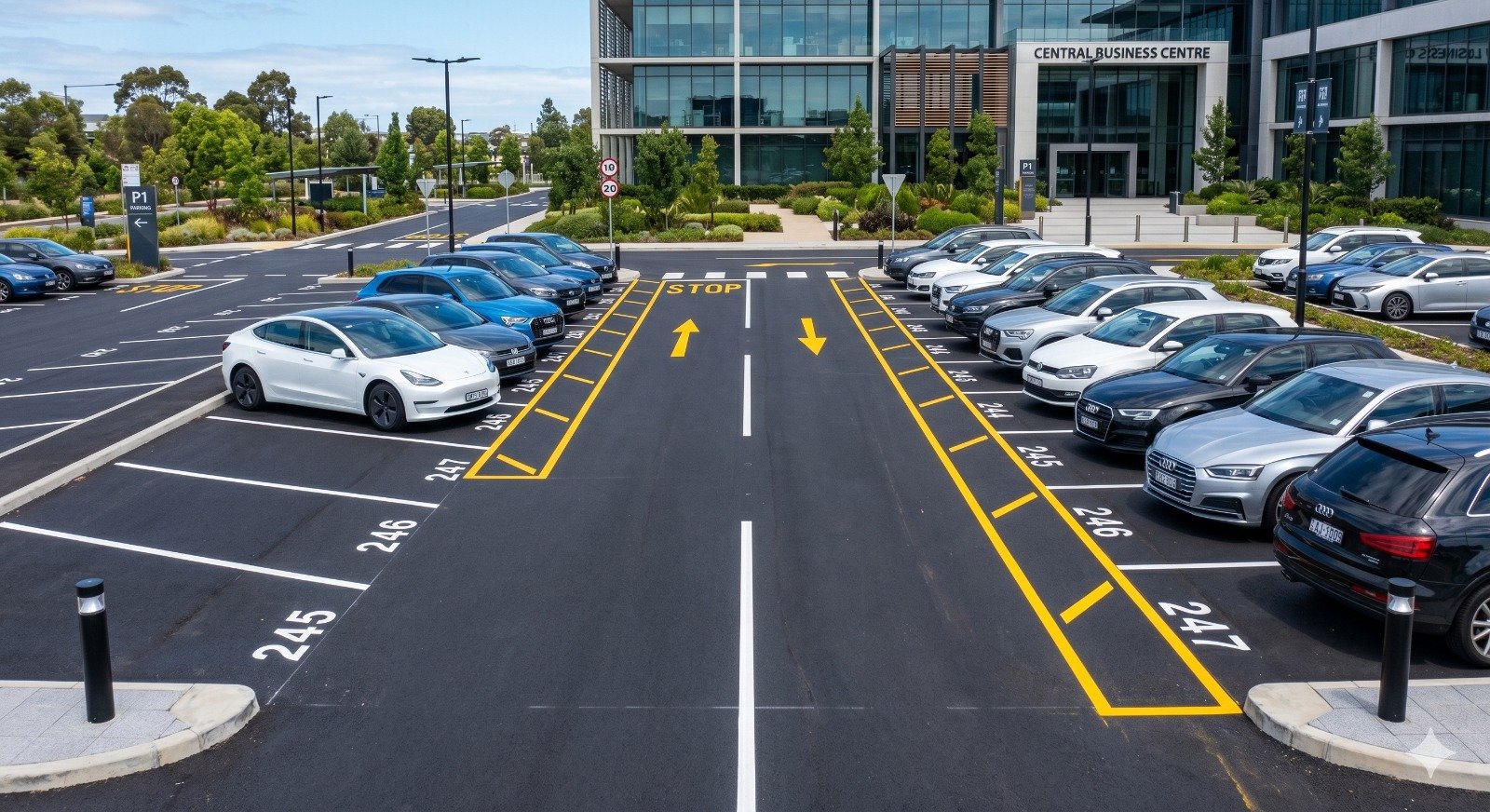
 Road Marking service in qatar
You paid for a car park to be marked in March. By August the bay lines are grey ghosts, the disabled bay symbol is unreadable, and someone has already reversed into a bollard because they could not see the hatching.
The instinct is to blame the contractor. Sometimes that is right. More often the marking was doomed before the first line was sprayed — by the surface it went onto, the product chosen, or the day it was applied.
Qatar is genuinely hard on road line marking. Surface temperatures on asphalt in July can exceed anything the paint was formulated for. Sand abrades the film like fine sandpaper under every tyre. Humidity affects curing. None of this makes long-lasting markings impossible — but it does mean the approach that works in a temperate climate will not survive here.
Here is what actually causes early fading, and what makes the difference.
The Surface Is Usually the Real Problem
Paint does not fail on its own. It fails because it never properly bonded to what was underneath.
The most common culprits:
Dust and sand. Qatar’s constant fine dust settles on asphalt within hours. Mark over it and the paint bonds to the dust layer, not the road. The first heavy traffic lifts it off in sheets.
Curing compound on new concrete. Fresh concrete car parks are treated with curing compounds that deliberately resist bonding. Marking over them without mechanical removal guarantees peeling.
Oil and tyre rubber. Existing car parks accumulate both. Neither can be swept away — they need degreasing or mechanical cleaning.
Trapped moisture. Marking a damp surface traps water under the film. It expands in the heat and blisters the paint from below.
A contractor who arrives, sweeps briefly and starts spraying is telling you something important about how the job will last.
Applying at the Wrong Time of Day
This one is invisible on the invoice and decisive in the outcome.
Asphalt in Qatar can reach surface temperatures well above air temperature during peak afternoon hours. Paint applied to a scorching surface skins over instantly at the top while the layer beneath is still wet. The result looks perfect on day one and delaminates within weeks.
Competent crews work early morning or overnight for exactly this reason. If a contractor offers to mark your car park at 2pm in July, the price probably reflects the quality.
The Wrong Product for the Traffic
Not all marking materials are meant to last the same length of time, and paying for the wrong one is a common and expensive error.
Water-based and solvent-based paints are economical and fast to apply. They suit car parks, internal roads, warehouse floors and anywhere traffic volume is moderate. They will not survive a busy highway.
Thermoplastic road marking is applied hot and forms a thick, durable film. It is the standard for public roads and high-traffic areas, and it carries glass beads for night visibility. It costs more upfront and lasts considerably longer where traffic is heavy.
Cold plastic and MMA systems are used where extreme durability is needed.
The mismatch usually goes one way: paint specified on a surface that needed thermoplastic, chosen because the quotation was lower. It is cheaper twice a year than thermoplastic once every few years — until you count the repeat closures and disruption.
Film Thickness Nobody Checks
Marking paint has a specified wet film thickness. Apply it thinner and the material stretches further, the job costs less, and the lines look identical on the day.
They fade in a fraction of the time.
This is the single most common way a low quotation is achieved, and it is almost impossible to detect by eye once dry. It is worth asking any contractor to state the film thickness they are applying and confirm it matches the specification.
Glass Beads and Night Visibility
If your markings need to be visible at night, glass beads are what makes that happen — they reflect headlight beams back to the driver.
Beads can be dropped onto the wet paint surface, mixed into the material, or both. Applied incorrectly, or in insufficient quantity, the lines look fine in daylight and disappear after dark. Bead loss also happens quickly on markings that were applied too thin to hold them.
For any road or car park used at night, this is worth specifying rather than assuming.
What to Ask Before You Appoint Anyone
Four questions that reveal a lot, quickly:
- How will the surface be prepared? You want a specific method, not “we’ll sweep it.”
- What time of day will you apply? Early morning or night in summer is the correct answer.
- What film thickness, and what material? Both should be stated, not implied.
- Will glass beads be applied, and how? Only relevant for night visibility — but ask if it matters to you.
A contractor who answers all four without hesitation is a different proposition from one who quotes a rate per metre and nothing else.
Where Manycon Fits
Manycon carries out road marking and line marking work across Qatar, alongside a broader construction scope that includes waterproofing, epoxy flooring, firestopping and concrete cutting.
Two things that matter for the problems above. First, road marking is delivered as a controlled process rather than a spray job — surface preparation and application timing treated as part of the work, not an optional extra. Second, fast mobilisation: marking usually has to happen in a narrow window when a car park can be closed or a road is quiet, and being able to move quickly is often what makes that window workable.
What Actually Makes Markings Last
Fading is rarely about the paint. It is about what was underneath it, when it was applied, how thick it went on, and whether the material suited the traffic it would carry.
If your markings are failing within a year, the fix is not simply remarking with the same approach. It is worth establishing which of those four went wrong first — otherwise you will be paying for the same job again next summer.
If you are planning marking works, or dealing with markings that have not lasted, contact Manycon on +974 7053 6538 or admin@manyconqatar.com for a site assessment and quotation.
Frequently Asked Questions
How long should road markings last in Qatar?
It depends on the material and traffic. Paint markings in a moderate-traffic car park should reasonably last one to two years. Thermoplastic on a well-prepared road surface lasts considerably longer. Markings failing within a few months point to a preparation, timing or thickness problem rather than normal wear.
Why do car park markings fade faster than road markings?
Usually because car parks are marked with paint rather than thermoplastic, and because concrete car park surfaces often carry curing compounds or oil contamination that prevents proper bonding. Turning movements in parking bays also scrub the surface more aggressively than straight-line driving.
Is thermoplastic always better than paint?
No. Thermoplastic is more durable and better suited to public roads and heavy traffic, but it costs more and is not necessary everywhere. For internal roads, warehouse floors and light-use car parks, good quality paint applied correctly is often the sensible choice. The mistake is using paint where thermoplastic was needed.
Can road markings be applied over old faded markings?
Sometimes, but not always. If the existing marking is still well bonded, remarking over it can work. If it is loose, peeling or heavily worn, the old material needs removing first — otherwise the new layer fails along with what is underneath it.
What is the best time of year to do road marking in Qatar?
Cooler months are easier, but marking is carried out year-round. What matters more than the season is the time of day — early morning or overnight application avoids the extreme surface temperatures that cause paint to skin over and delaminate.
Do road markings need glass beads?
Only where night visibility matters — public roads, entrances, external car parks used after dark. Beads reflect headlights back to the driver. Internal warehouse floors and daytime-only areas generally do not need them.
How do I know if a road marking company in Qatar is doing the job properly?
Ask about surface preparation method, application timing, film thickness and material specification. A contractor who can answer those clearly is treating it as a technical job. One who only quotes a rate per linear metre may be achieving that rate by thinning the material.
