

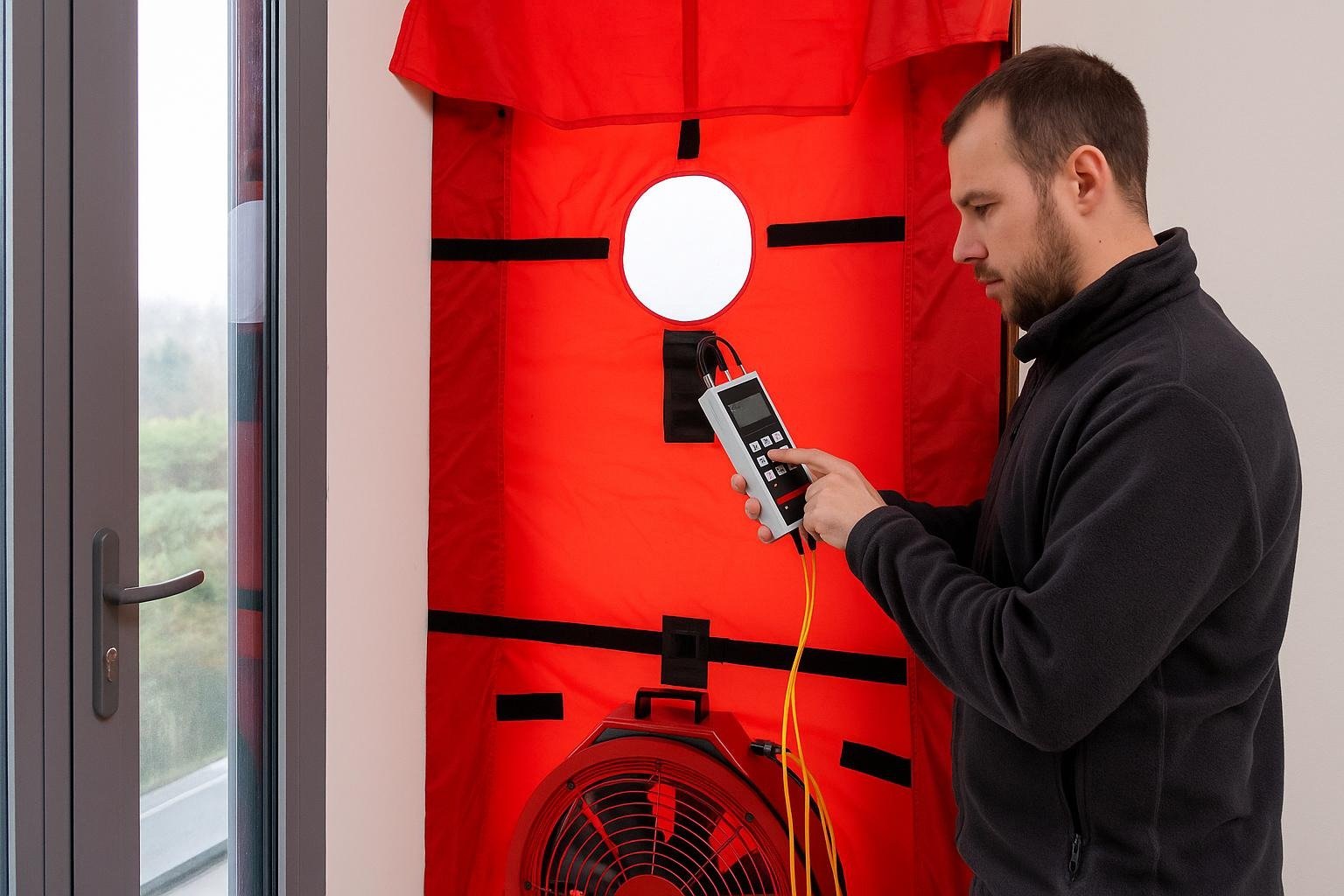
 Air Tightness Testing Service in Qatar
Let me paint a picture you might recognise.
You have just completed a brand-new villa in Al Rayyan. The contractor hands over the keys, the fit-out team has done a brilliant job, and the client moves in expecting their energy bills to reflect the brand-new, supposedly efficient building they just paid a small fortune for. Three months later, the air conditioning is running full blast every single day, the electricity bill is higher than expected, and nobody can quite figure out why.
More often than not, the answer comes down to one thing: uncontrolled air leakage.
Buildings across Qatar — from luxury villas in The Pearl to commercial towers in Lusail — lose a significant portion of their cooled or heated air through gaps, cracks, and penetrations that most people never see and never think about. In a country where summer temperatures regularly exceed 45°C and air conditioning accounts for the majority of a building’s energy consumption, this is not a small problem. It is an expensive one.
This is exactly where a professional air tightness testing service in Qatar becomes less of a nice-to-have and more of a genuine necessity.
What Is Air Tightness Testing and Why Does It Matter in Qatar?
Air tightness testing — also called a blower door test or building envelope pressure test — is a standardised diagnostic procedure that measures how much air leaks in or out of a building through unintended gaps and openings in the building fabric.
The test itself is straightforward enough. A calibrated fan is temporarily fitted into an external door or window frame, and the fan either pressurises or depressurises the building to a set pressure differential — typically 50 Pascals. The amount of air the fan needs to push or pull to maintain that pressure directly indicates how airtight (or leaky) the building envelope is.
The result is typically expressed as:
– Air changes per hour at 50 Pascals (ACH50) — the number of times the building’s entire air volume is exchanged per hour under test conditions.
– m³/h/m² @ 50 Pa — the air leakage rate per square metre of building envelope area, which is the metric most commonly referenced in Qatari and Gulf building standards.
In Qatar’s climate context, air leakage is one of the biggest contributors to cooling load. Every cubic metre of hot, humid outdoor air that sneaks into a conditioned building has to be cooled and dehumidified by the air conditioning system — consuming energy and money in the process, every single hour the building is occupied.
Why Qatar Specifically Needs Air Tightness Testing Services
Some countries treat air tightness testing as an optional extra. In Qatar, the conversation has changed significantly over the past several years — and for good reason.
GSAS Compliance and Qatar’s Green Building Mandate
The Global Sustainability Assessment System — GSAS — is Qatar’s mandatory green building rating framework, developed by the Gulf Organisation for Research and Development (GORD). GSAS addresses energy performance, indoor environment quality, and building envelope performance, and air tightness sits squarely within its scope.
For projects targeting GSAS certification — which is increasingly required for government-funded and major commercial developments across Qatar — demonstrating a compliant air permeability result is part of the process. An air tightness testing company in Qatar that understands GSAS requirements and the associated documentation process can make the difference between a smooth certification submission and costly delays.
Qatar National Construction Standards
Qatar’s National Construction Standards (NCS) align with international best practice on building envelope performance, and air permeability is an area of growing focus as Qatar works toward its National Vision 2030 sustainability targets. New buildings, particularly in the residential and hospitality sectors, are increasingly expected to demonstrate their energy performance credentials through measured data — not just calculations.
The Economic Case in a High-Energy-Cost Context
Even setting aside regulatory requirements entirely, the economic argument for building air tightness testing in Qatar is compelling on its own merits.
A building with a high air leakage rate runs its cooling systems harder, wears mechanical equipment out faster, and costs its occupants more in energy bills every single month for the entire life of the building. A one-off air tightness test — carried out during construction and followed up with targeted remediation to seal identified leakage paths — is a modest investment compared to decades of unnecessary energy expenditure.
What Happens During an Air Tightness Test? A Step-by-Step Guide
If you have never commissioned an air tightness test in Qatar before, knowing what to expect from the process helps you plan properly and prepare the building correctly.
Step 1 — Pre-Test Preparation
Before the test fan is installed, the building needs to be in a specific condition. All external doors and windows are closed. Internal doors are typically left open so the whole building is measured as a single pressurised zone. Intentional openings — ventilation grilles, trickle vents, letterboxes — are temporarily sealed, since the test is measuring unintentional leakage only.
For buildings with mechanical ventilation systems, the ventilation ducts are sealed at their termination points before testing begins.
Step 2 — Fan Installation and Baseline Measurement
The blower door fan unit is installed in a suitable external opening — usually a front door — using a flexible panel frame. The fan is connected to a digital pressure gauge and data logger, and a baseline measurement is taken before the fan is switched on to account for any wind effect on the building.
Step 3 — Pressurisation and Depressurisation Testing
The fan runs through a series of pressure steps — typically from 10 Pa up to 60 Pa and back down again. At each pressure step, the airflow required to maintain that pressure is recorded. The test is generally run in both pressurisation (blowing air into the building) and depressurisation (drawing air out) modes, and the results are averaged.
The full test sequence typically takes one to two hours for a residential property and longer for larger commercial buildings.
Step 4 — Results Analysis and Reporting
Once the test data is collected, the air permeability result is calculated and compared against the project specification or the relevant standard. A good air tightness testing services Qatar provider will produce a formal test report that includes the raw data, the calculated result, a comparison against the target or benchmark, and — where the result falls short — practical recommendations for remediation.
Step 5 — Remediation and Retest (Where Required)
If the building fails to meet its target air permeability result, the next step is identifying where the leakage is coming from. This is typically done using a combination of smoke pencils or thermal imaging while the building is under pressure — watching for telltale air movement or thermal signatures at penetrations, service entries, window reveals, and junctions between building elements.
Once leakage paths are sealed, a retest confirms the improvement.
Common Sources of Air Leakage in Qatar Buildings
Understanding where air leaks most commonly occur helps both builders and building owners understand what to look for and where the biggest gains are typically found.
-Window and door frames — especially at the junction between the frame and the surrounding masonry, where sealant may have been applied poorly or has shrunk over time
– Service penetrations — pipes, cables, and conduits that pass through external walls or the roof structure, often without an adequate seal around them
– Junction between floors and external walls — particularly at balcony interfaces and at the base of external walls where they meet floor slabs
– Roof level penetrations — soil vent pipes, drainage outlets, cable entries, and plant penetrations that pass through flat roof decks
– Recessed downlights and electrical back boxes — in ceilings below a cold roof or at the building envelope, these are notoriously leaky if not specifically sealed
– Air handling unit connections and ductwork penetrations — where mechanical system components pass through the building envelope
Who Needs Air Tightness Testing Services in Qatar?
Residential developers and villa builders — particularly those targeting GSAS certification or building for clients who expect energy-efficient homes and lower running costs.
Commercial property developers— office buildings, hotels, mixed-use developments, and retail units all benefit from a tight envelope, particularly in Qatar’s harsh climate where cooling loads dominate energy consumption year-round.
EPC contractors and main contractors — for whom a passing air tightness test result is part of the contractual deliverable, particularly on government or semi-government projects.
Facilities managers and building owners — who are investigating the root cause of unexpectedly high energy bills in an existing building. A diagnostic air test can identify whether the envelope is contributing to the problem.
Green building consultants and GSAS assessors — who need measured envelope performance data to support certification submissions.
What to Look for in an Air Tightness Testing Company in Qatar
Not every testing provider is equal, and in a specialist technical field like this, choosing the right company matters considerably.
Accreditation and Certification
Look for testers who hold recognised industry accreditation — the UK’s ATTMA (Air Tightness Testing and Measurement Association) scheme is the most widely recognised internationally, and its TSL1 and TSL2 certifications confirm that a tester has been assessed against a defined standard of competence and equipment calibration. UKAS-accredited test bodies go a further step, providing third-party oversight of the testing process.
Experience With Qatari Building Types and Standards
A tester familiar with the GSAS framework, Qatar’s construction norms — including flat-roofed concrete frame construction, high-specification glazing systems, and split-system or VRF air conditioning configurations — will deliver more useful results and better remediation advice than one who has experience only with UK or European lightweight timber-frame buildings.
Equipment Calibration Records
The blower door fan and associated pressure measurement equipment must be within its calibration period. Ask for calibration certificates before the test. Out-of-calibration equipment produces unreliable data — and an unreliable test result is worse than no test at all in a compliance context.
Comprehensive Reporting
A professional air tightness testing company in Qatar should deliver a test report that meets the requirements of the applicable standard — whether that is ISO 9972, CIBSE TM23, or a project-specific specification — including all raw data, the calculated result, uncertainty analysis, and clear pass/fail determination against the target.
Air Tightness Testing — Frequently Asked Questions
How much does air tightness testing cost in Qatar?
The cost of an air tightness test in Qatar varies depending on the size and complexity of the building, the number of test zones, travel requirements, and the level of reporting needed. For a standard residential villa, indicative costs typically run between QAR 1,500 and QAR 4,000 for a single test. Commercial buildings are priced based on floor area and the number of separately tested zones. Many providers offer fixed-price packages for GSAS certification projects.
When during construction should air tightness testing be carried out?
Ideally, air tightness testing in Qatar should be carried out at two stages. A pre-completion test — sometimes called an interim or mid-construction test — is carried out while construction is still under way, giving the contractor the opportunity to identify and rectify leakage paths before finishes cover them up. A final test then confirms the completed building’s performance. Waiting until after handover to test for the first time significantly increases the cost and difficulty of any remediation required.
How long does an air tightness test take?
For a typical residential villa of 200–400 m², the test itself takes approximately one to two hours once the building is properly prepared. Preparation — closing windows, sealing ventilation openings, and setting up the fan — adds another 30 to 60 minutes. For larger commercial buildings tested in multiple zones, a full day or multiple days may be required.
What is a good air permeability result for buildings in Qatar?
Under GSAS and aligned international standards, an air permeability of 5 m³/h/m² @ 50 Pa or better is generally considered acceptable for standard residential and commercial buildings. More demanding standards — such as those applicable to Passive House or high-performance green building specifications — may target 1.0 m³/h/m² @ 50 Pa or lower. Your building specification or GSAS assessor will confirm the target applicable to your specific project.
Can air tightness testing be carried out on an existing building, not just new-build?
Yes. Existing buildings can be tested at any time, and diagnostic testing on existing buildings is increasingly common in Qatar as facilities managers investigate the causes of high energy consumption. For an existing building in occupation, the test preparation is slightly more involved — occupants need to be advised, movable items near external openings may need to be repositioned, and any open fireplaces or gas appliances require careful management. But the test itself follows the same process as for a new-build.
Does a building need to pass air tightness testing to get GSAS certification?
GSAS addresses building envelope performance as part of its energy efficiency criteria, and air permeability data may be required to support specific credit submissions depending on the project type and certification level being targeted. Your GSAS assessor or a specialist air tightness testing company in Qatar familiar with the GSAS framework will be able to advise on the specific requirements for your project.
Conclusion
Air tightness testing is one of those technical processes that sounds niche until you understand what is actually at stake — and then it becomes obvious why it matters.
In Qatar’s climate, where buildings battle extreme heat and humidity every day of the year and where cooling energy consumption dominates operational costs, a building that leaks air is a building that costs its occupants more than it should. Every day. For decades.
The good news is that **air tightness testing services in Qatar** are available, the testing process itself is well understood and technically straightforward, and the cost of testing and remediation is genuinely modest compared to the lifetime energy savings a tight building delivers.
Whether you are a developer looking to demonstrate GSAS compliance, a contractor wanting to confirm your building meets its design specification, or a building owner trying to understand why the electricity bill never seems to come down — commissioning a professional air tightness test is a concrete, measurable step toward solving the problem.
Get the test done early. Seal what needs sealing. And own a building that actually performs the way it was supposed to.
