

 Fire proofing service
A contractor quotes you for “fire protection.” The scope says fireproofing. You assume that covers the whole building, sign it, and move on.
Six months later the inspector asks about the penetrations in your riser walls. Nobody priced them. Nobody did them. The steel is beautifully coated and the compartment walls are full of unsealed holes.
This mix-up happens constantly, and it happens because the two words sound like they mean the same thing. They don’t. They protect different parts of the building, use different materials, and one cannot substitute for the other.
If you’re specifying, tendering or approving fire protection work in Qatar, this is worth ten minutes of your time.
The Simplest Way to Tell Them Apart
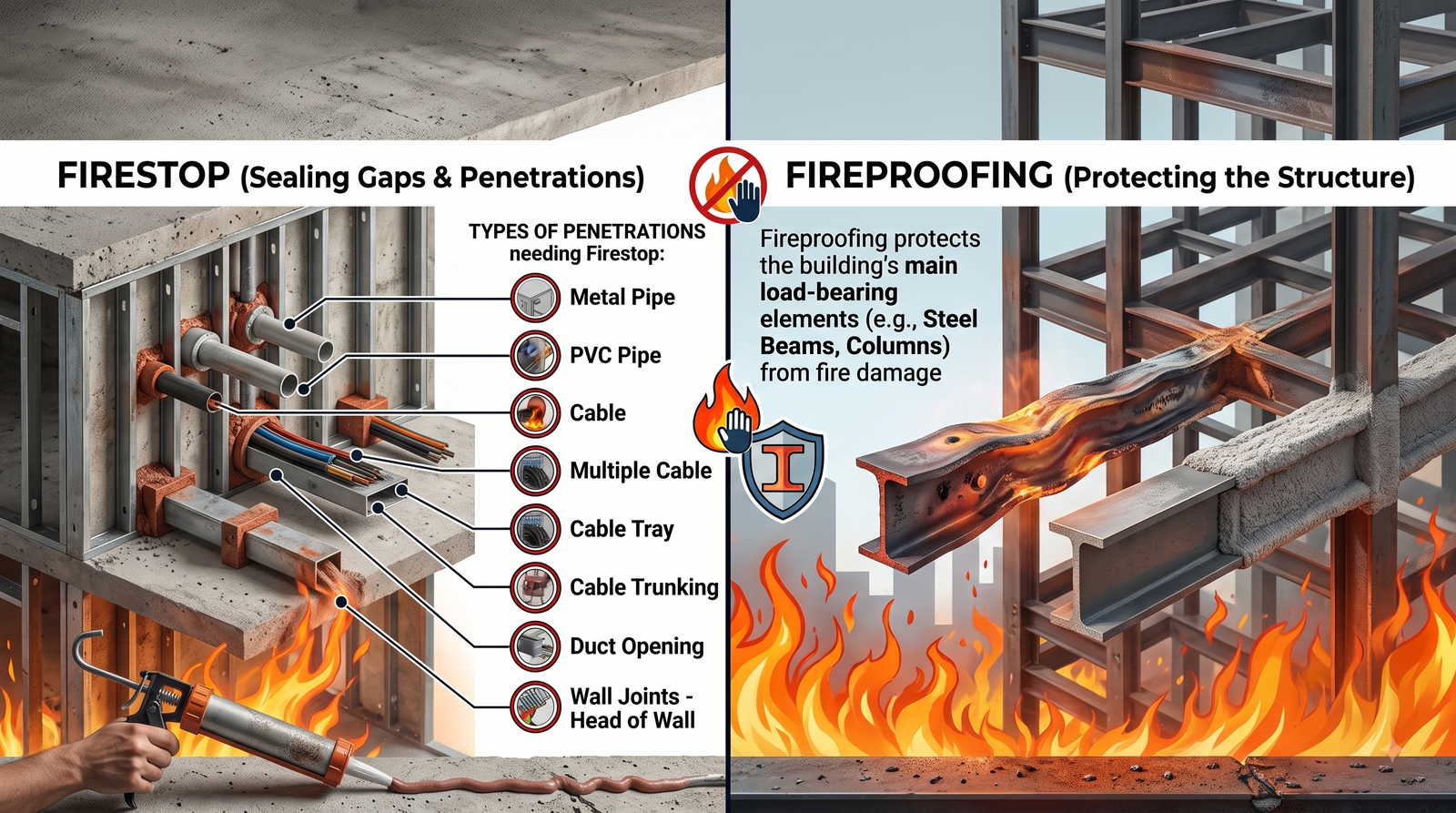
Fireproofing protects the structure. Firestopping protects the barriers.
That’s the whole distinction in one line.
Fireproofing goes onto structural steel — beams, columns, bracing. Steel doesn’t burn, but it weakens as it heats and can deform under load long before a fire is out. Fireproofing insulates the steel so it holds its strength for a specified period, typically one to three hours. Without it, the building can come down while the fire is still contained to one floor.
Firestopping seals the openings in fire-rated walls and floors. Every pipe, cable, duct and cable tray that passes through a rated barrier punches a hole in it. Firestopping fills that hole with a tested system rated to match the wall. Without it, fire and smoke travel through the gaps and the compartmentation the building was designed around stops working.
Both fall under passive fire stopping and passive fire protection — systems that work without needing to activate, unlike sprinklers or alarms.
Where Each One Is Actually Required
You need fireproofing where there’s structural steel carrying load. Steel-framed warehouses, industrial buildings, car park structures, exposed steel in commercial buildings, plant rooms. Concrete structures generally don’t need it, since concrete already has inherent fire resistance.
You need firestopping wherever services cross a fire-rated barrier. Risers, service shafts, corridor walls, floor slabs between levels, plant room walls, stairwell enclosures. This applies to virtually every building type — concrete, steel or blockwork.
That’s the key asymmetry. A concrete building may need no fireproofing at all but will still need extensive firestopping. Assuming “no steel means no fire protection scope” is one of the more expensive misreadings on a project.
The Materials Are Completely Different
Fireproofing comes in two main forms in Qatar. Cementitious spray is a thick, robust coating applied to steel — economical and durable, standard in plant rooms, car parks and industrial areas where appearance doesn’t matter. Intumescent coating is a thin paint-like film that swells into an insulating char when heated, used where steel is exposed and needs to look finished.
Firestopping uses a much wider range: firestop sealant for small gaps, intumescent wraps and collars for plastic pipes that melt away, mineral wool with coating systems for large openings, pillows and blocks for cable trays that need future access, and fire-rated mortar for large penetrations.
One critical point: fire sealant is not the same as ordinary construction sealant. Standard silicone has no fire rating. Substituting it — which happens more often than it should — leaves you with something that looks correct and performs like nothing at all.
Why the Confusion Costs Real Money
Three ways this goes wrong on Qatar projects:
Scope gaps in tender. A package written as “fireproofing” gets priced as steel coating only. The firestopping never appears in anyone’s scope until inspection.
One contractor covered both badly. Fireproofing needs spray equipment and thickness calculation per steel section. Firestopping needs tested system knowledge and detail-by-detail matching. A crew competent at one isn’t automatically competent at the other.
Sequencing failures. Fireproofing happens early, on exposed steel. Firestopping happens late, after MEP services are installed — and before ceilings close. Treating them as one activity means firestopping gets compressed into whatever time is left.
What to Ask Before Appointing Anyone
Four questions that separate a genuine specialist from a general contractor with a spray gun:
- “Is firestopping included, and priced separately from fireproofing?” If the answer is vague, the scope gap already exists.
- “Which tested system for each penetration type?” Competent firestopping contractors name specific tested systems for specific configurations. A product brochure isn’t an answer.
Where Manycon Fits
Manycon works across Qatar as a firestopping and fireproofing company in Qatar, delivering both disciplines alongside a wider construction scope that includes waterproofing, epoxy flooring, GRP lamination, road marking and concrete cutting.
Two things that matter for the problems above. First, both scopes under one contractor — which removes the gap where firestopping quietly falls between packages. Second, fast mobilisation, because firestopping in particular tends to land on the critical path late, when the window between MEP completion and ceiling installation is narrow.
The Short Version
Fireproofing keeps the structure standing. Firestopping keeps the fire in one place. You need whichever your building requires — and most buildings need firestopping regardless of whether they need fireproofing at all.
If you’re reviewing a fire protection scope and can’t tell which of the two it actually covers, that’s worth resolving before it’s signed rather than at inspection.
Contact Manycon on +974 7053 6538 or admin@manyconqatar.com for a scope review or quotation.
Frequently Asked Questions
Does every building need both?
No. Buildings with structural steel need fireproofing; concrete-framed buildings usually don’t. But almost every building needs firestopping, because services pass through fire-rated barriers in nearly all construction types.
Is fire sealant the same as normal sealant?
No. Firestop sealant is a tested product formulated to maintain the fire rating of the barrier it seals. Ordinary construction silicone carries no fire rating and will not perform in a fire, regardless of how similar it looks once applied.
Can one contractor do both firestopping and fireproofing?
Yes, and there are advantages to it — mainly that nothing falls between packages. What matters is that the contractor demonstrates competence in both, since the skills differ: fireproofing requires spray application and thickness calculation, firestopping requires tested system knowledge.
When should firestopping be done on a project?
After MEP services are installed and before ceilings, risers and shafts are closed. This window is often short, which is why firestopping is a common cause of handover delay when it isn’t planned for.
What happens if firestopping is missed?
Fire and smoke travel freely through the unsealed openings, bypassing the compartment walls entirely. Practically, it also means the building won’t pass Civil Defence inspection, and the remedy usually involves opening up finished ceilings.
Does firestopping need redoing after building modifications?
Yes. Any new cable, pipe or duct through a fire-rated barrier creates a new penetration requiring a rated seal. Fit-out works and MEP upgrades routinely breach existing firestopping, and reinstatement is frequently overlooked.
