

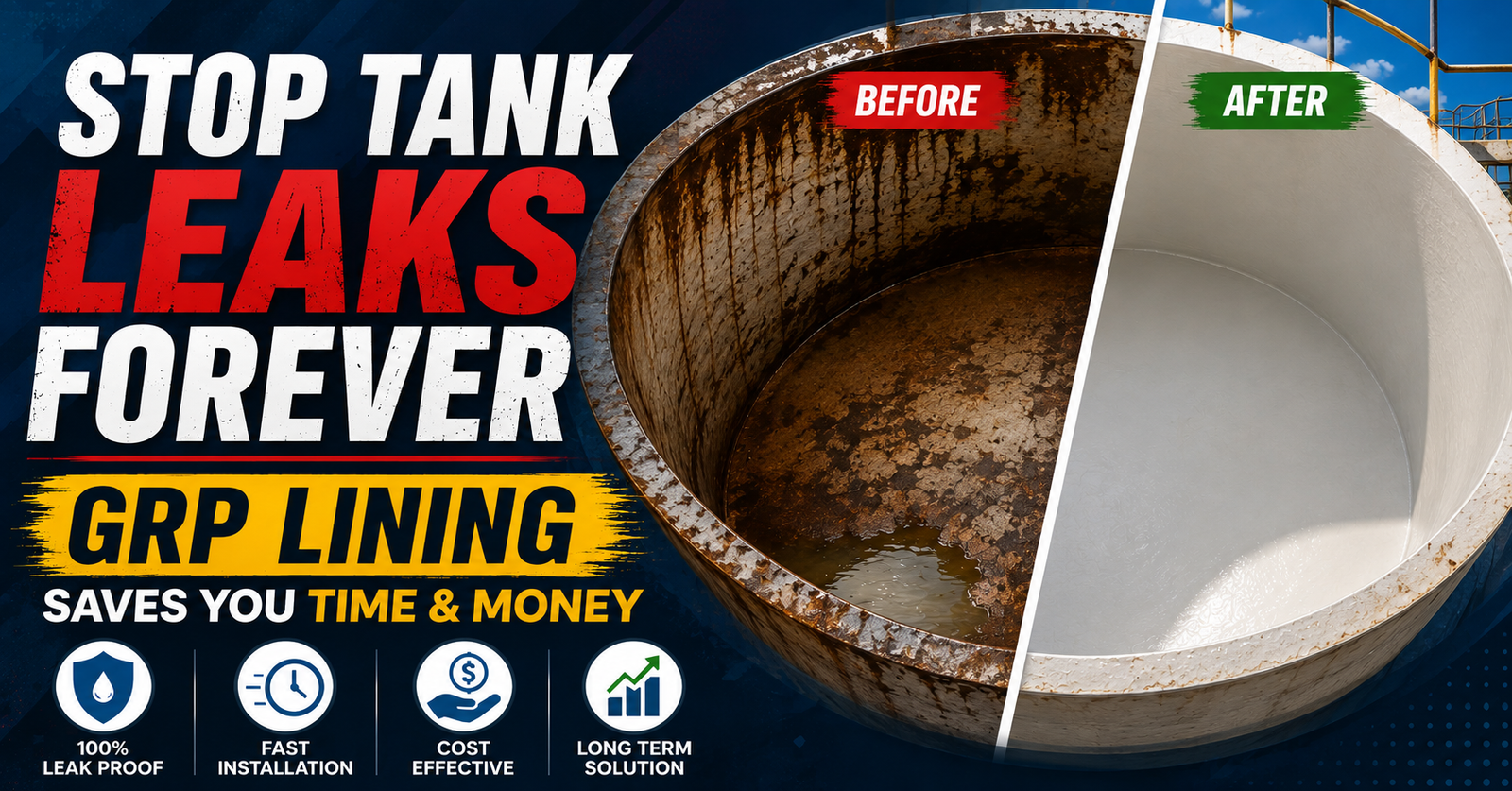
 best grp lining service in qatar
The tank was patched last year. And the year before that. Each time someone finds the crack, chips it out, fills it, and the leak stops — for a while.
Then a damp patch appears somewhere new on the outside wall, and the cycle starts again.
If that sounds like your water tank, the problem probably isn’t the crack you keep repairing. It’s that concrete tanks in Qatar are working against thermal movement, ground salts and constant water pressure, and a patch repair addresses a symptom in one spot while the rest of the surface carries on doing the same thing.
GRP lining takes a different approach — and for tanks that leak repeatedly, it usually works out cheaper than the third or fourth patch.
What GRP Lining Actually Is
GRP stands for Glass Reinforced Plastic — fibreglass matting bonded to the tank surface with resin, built up in layers and finished with a topcoat.
The important word is seamless. Instead of sealing individual defects, GRP lining creates one continuous membrane across the entire internal surface — floor, walls, corners, up over the wall junctions. There are no joints for water to find, because there are no joints.
It bonds to the substrate rather than sitting loose inside it, so water pressure pushes it against the concrete instead of behind it. And because the fibreglass has some flex, it accommodates minor structural movement that would crack a rigid repair.
Typical applications in Qatar: concrete water tanks, potable water storage, fire water tanks, chemical storage, sumps and pits, and secondary containment bunds.
Why Patch Repairs Keep Failing
Three reasons the same tank keeps leaking:
The crack you found isn’t the only one. Visible cracks are the ones that reached the surface. Concrete under sustained water pressure develops microcracking across the whole face. Repair one and water simply finds the next.
Repairs are rigid, tanks move. Qatar’s temperature swings cause expansion and contraction. A rigid cementitious patch has different movement characteristics from the surrounding concrete, so stress concentrates at the repair edge — and it cracks again, usually just alongside where you fixed it.
Ground salts attack from behind. Qatar’s groundwater carries high salt content. Where it reaches the concrete, it degrades gradually. Surface repairs do nothing about deterioration happening from the outside in.
A lining doesn’t fix the concrete. It stops water reaching it, which is the more useful outcome.
Where GRP Makes Financial Sense — and Where It Doesn’t
It makes sense when:
- The tank has leaked more than once
- You’re paying for repeated patch repairs and repeated tank downtime
- Water loss is measurable on your consumption
- The tank stores potable water and contamination risk matters
- The tank holds chemicals that attack bare concrete
- The structure is sound but the surface is deteriorating
It’s not the right answer when:
- The tank has structural failure — cracked slab, settlement, reinforcement corrosion causing spalling. Lining a structurally compromised tank hides the problem rather than solving it. Structural repair comes first.
- The tank is due for replacement anyway
- The leak is at a pipe penetration or valve, not the tank fabric
An honest GRP lining company in Qatar should tell you which situation you’re in before quoting. If nobody has inspected the tank empty and dry, nobody knows yet.
The Part That Determines Whether It Lasts
Almost every GRP lining failure traces back to surface preparation, not the lining itself.
The tank must be fully drained, cleaned and dried. The surface needs mechanical preparation — grinding or blasting — to remove laitance, contamination and any previous coating. Existing defects need filling. Moisture content must be within limits before lamination starts.
This is unglamorous, time-consuming work, and it’s where a low quotation is usually achieved. A lining applied over a damp or contaminated surface will delaminate, sometimes within months, and the only remedy is to strip it out and start again.
Ask specifically how the surface will be prepared and how moisture will be verified. The answer tells you more than the price does.
Five Questions Before You Appoint Anyone
- “Will you inspect the tank empty before quoting?” A price given without seeing the inside is a guess.
- “How will the surface be prepared, and how is moisture checked?” You want a method, not “we’ll clean it.”
- “How many layers, and what total thickness?” Should be stated, not left open.
- “How long does the tank need to be out of service?” This affects your operations more than most owners expect.
Where Manycon Fits
Manycon provides GRP lining services across Qatar, alongside waterproofing, firestopping, fireproofing, epoxy flooring, road marking and concrete cutting.
Two things relevant to the above. First, GRP lining sits alongside a broader waterproofing and structural repair capability — useful when an inspection reveals the tank needs structural attention before lining, since that doesn’t require bringing in a second contractor. Second, fast mobilisation, which matters when a tank has to be taken out of service and every extra day offline is a real operational cost.
The Practical Takeaway
If you’re patching the same tank repeatedly, you’re not solving the problem — you’re paying for it in instalments, plus downtime each time.
Get the tank inspected empty and dry, establish whether the structure is sound, and price a full lining against what you’ve spent on repairs over the last three years. For most tanks that have leaked more than twice, the comparison isn’t close.
To arrange a tank inspection or quotation, contact Manycon on +974 7053 6538 or admin@manyconqatar.com.
Frequently Asked Questions
What is GRP lining used for?
GRP lining creates a seamless fibreglass membrane inside tanks and containment structures. It’s used for concrete water tanks, potable water storage, fire water tanks, chemical storage, sumps, pits and secondary containment bunds — anywhere a liquid needs to be kept in and the substrate protected.
How long does GRP tank lining last?
Correctly applied over a properly prepared surface, a GRP lining is designed to last many years with minimal maintenance. Lifespan depends far more on surface preparation and the stored contents than on the lining material itself. Poor preparation is the main cause of early failure.
Is GRP lining safe for drinking water tanks?
It can be, but only where the specific resin system carries potable water approval. Not all GRP systems do. Ask which approval the system holds before it’s applied to a potable water tank — this is not a detail to assume.
Is GRP lining better than waterproof coating?
For tanks that have leaked repeatedly, generally yes, because it’s a continuous membrane rather than a surface treatment and it tolerates minor movement. For a sound tank needing routine protection, a coating may be sufficient and cheaper. The right choice depends on the tank’s condition.
How long does the tank need to be out of service?
It varies with tank size, condition and the number of layers, but the sequence is drain, clean, prepare, dry, laminate, cure. Drying time is often the longest element and can’t be rushed without compromising the bond. Ask for a specific programme before committing.
