
 Uncategorized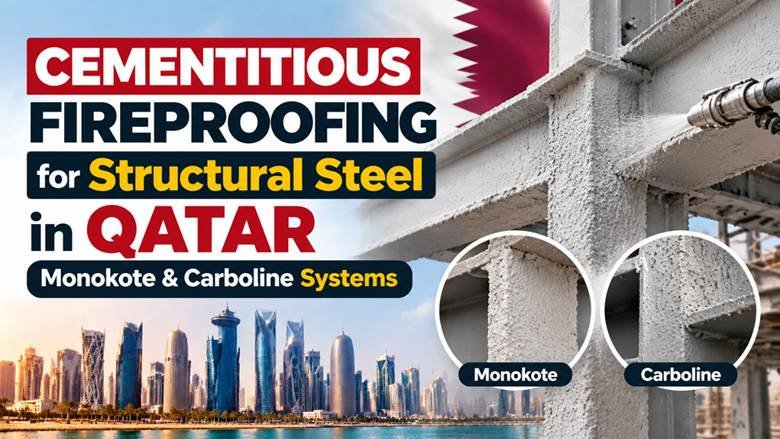
Two identical steel columns. Same building, same required rating, same product sprayed on the same day by the same crew.
One passes thickness testing. The other doesn’t — and nobody can say why until someone checks the section sizes and realises they were never different columns at all in the eyes of the applicator. They were sprayed to one number because one number was easier.
That, in a sentence, is the most common failure in cementitious fireproofing Qatar projects. Not bad material. Not bad workmanship. A calculation that never happened.
This article covers how these systems work, what Monokote and Carboline products actually are, and the handful of details that decide whether a commercial fireproofing Qatar job holds up under inspection.
What Cementitious Fireproofing Is
Cementitious fireproofing belongs to a category called spray applied fire resistive material (SFRM) — a gypsum or cement-based mix, sprayed wet onto steel beams and columns, which cures into a rigid insulating layer.
The mechanism is thermal delay. Bare steel in a fire reaches temperatures that compromise load capacity within minutes. A cementitious layer slows heat transfer into the section, extending the time before that happens. The specified fire rating hours — one, two, three — describe how long the protected member maintains capacity, not how long the coating survives.
It’s grey, textured and unattractive. That’s why it lives in places nobody looks at: plant room ceilings, car park structure soffits, warehouse frames, service voids, industrial roofs.
Monokote and Carboline: What They Actually Are
Monokote is GCP Applied Technologies’ SFRM range and probably the most widely specified name in the category. Its products cover standard interior applications through to higher-density formulations for exposed or semi-exposed conditions.
Carboline produces both SFRM and intumescent coating systems, including the Pyrocrete range — higher-density, more impact-resistant materials used where the steel takes physical abuse or sits in harsher environments.
What matters for specification isn’t brand preference. It’s these three things:
Density. Standard-density products suit dry interior conditions. Medium and high-density products resist impact and moisture — relevant for car parks, external plant areas and anywhere Qatar’s humidity reaches the steel.
UL listing. Every product carries UL listed designs specifying exactly which steel sections it protects, to which rating, at which thickness. That listing is what makes an installation defensible. A product without a listing covering your configuration is a product you cannot evidence.
Primer compatibility. SFRM bonds to the steel or to the shop primer on it. Some primers are compatible, some aren’t, and some need a bonding agent. Getting this wrong produces coating that looks perfect and releases in sheets months later.
The Number That Decides Everything
Dry film thickness is not one figure for a building. It’s calculated per member.
Steel sections heat at different rates depending on their Hp/A section factor — the ratio of heated perimeter to cross-sectional area. A slender member with a lot of exposed surface relative to its mass heats fast and needs more protection. A heavy column heats slowly and needs less.
Applying a single thickness across a frame therefore does two things at once: it over-coats the heavy sections, wasting material, and it under-coats the light ones, leaving them non-compliant. The second is the one that shows up at testing.
Thickness verification is done with a depth gauge to a defined sampling pattern. Ask how it will be measured and recorded before work starts, not after.
Where Jobs Actually Go Wrong
Surface contamination. Oil, dust and loose mill scale prevent adhesion. Qatar’s airborne dust settles on erected steel continuously, so steel cleaned last week isn’t clean today.
Wrong density for the environment. Standard-density material specified for a car park soffit will degrade where standard-density material was never meant to go.
Damage by following trades. Hangers drilled through cured coating, sections scraped during MEP installation, overspray cleaned off along with the coating underneath. Damage repair is legitimate work and should be programmed for, not treated as an argument.
Application conditions. These materials have temperature and humidity limits for application and curing. Spraying outside them affects bond strength in ways that don’t show for months.
Cementitious or Intumescent — Which Fits
Choose cementitious where the steel is concealed or appearance is irrelevant, where you want the lower material cost, and where impact resistance matters more than finish.
Choose intumescent where steel is architecturally exposed, where a thin smooth finish is needed, or where the member will be seen in a completed space.
The mistake runs in both directions: cementitious sprayed on feature steelwork that someone then has to box in, and intumescent specified across a warehouse frame at several times the necessary cost.
What to Establish Before Appointing a Fireproofing Company
Ask these four, and listen for specificity:
- “How is thickness verified, and what sampling pattern?” A documented method with recorded readings.
- “Have you confirmed compatibility with our shop primer?” If the primer hasn’t been checked, adhesion hasn’t been considered.
A fireproofing company that answers all four without hedging is treating the work as engineering rather than spraying.
Where Manycon Fits
Manycon delivers structural steel protection across Qatar as a specialist subcontractor to main contractors — cementitious systems alongside intumescent coatings, firestopping and wider passive fire protection, plus epoxy flooring, GRP lining, road marking and concrete cutting.
Two things bear on the issues above. Thickness verification and coating records are produced in the format main contractors and consultants need for their own submissions, which removes a common source of friction at closeout. And because firestopping sits under the same team, coating damage caused during penetration sealing gets reinstated rather than disputed across two subcontracts.
The Practical Takeaway
Cementitious fireproofing is a straightforward material with one demanding requirement: the right thickness on the right section, applied to properly prepared steel, verified and recorded.
If you’re reviewing a quotation and it prices a single thickness across the whole frame, that’s worth questioning before awarding. It’s a reliable indicator that the section calculation hasn’t been done.
For a fireproofing scope review or quotation, contact Manycon on +974 7053 6538 or admin@manyconqatar.com.
Frequently Asked Questions
What is cementitious fireproofing?
A cement or gypsum-based material sprayed onto structural steel, which cures into a rigid insulating layer. It slows heat transfer into the steel during a fire so the member retains load capacity for the specified rating period.
Is Monokote better than Carboline?
Neither is universally better. Both manufacturers produce SFRM ranges spanning standard to high-density formulations. Selection should follow the application environment, required rating and UL design coverage for your steel sections rather than brand.
How thick does cementitious fireproofing need to be?
It varies by steel member. Thickness is determined by the section’s Hp/A factor and the required rating, as set out in the applicable UL design. A single thickness applied across an entire frame indicates the calculation hasn’t been performed.
Can cementitious fireproofing be used outdoors in Qatar?
Only with products formulated for exposed or semi-exposed conditions. Standard interior-grade SFRM degrades when exposed to weather and humidity. Density and formulation must match the environment.
What happens if fireproofing is damaged after installation?
It must be repaired to the original specification. Damaged coating leaves the steel unprotected at that point, and inspectors check for it. Repair responsibility is worth agreeing in the contract, since damage by following trades is near-inevitable.
SEO Title
Cementitious Fireproofing in Qatar: Monokote & Carboline Systems
Meta Description
How cementitious fireproofing protects structural steel in Qatar — Monokote and Carboline systems, thickness rules, and what separates a lasting job from a failing one.
Suggested URL Slug
cementitious-fireproofing-qatar
Primary Keyword
Cementitious fireproofing Qatar
Secondary Keywords
Fireproofing company, commercial fireproofing Qatar
LSI Keywords
Spray applied fire resistive material (SFRM), Monokote, Carboline, structural steel protection, fire rating hours, dry film thickness, bond strength, primer compatibility, Hp/A section factor, intumescent coating, overspray, steel beams and columns, UL listed, plant room, car park structure
